
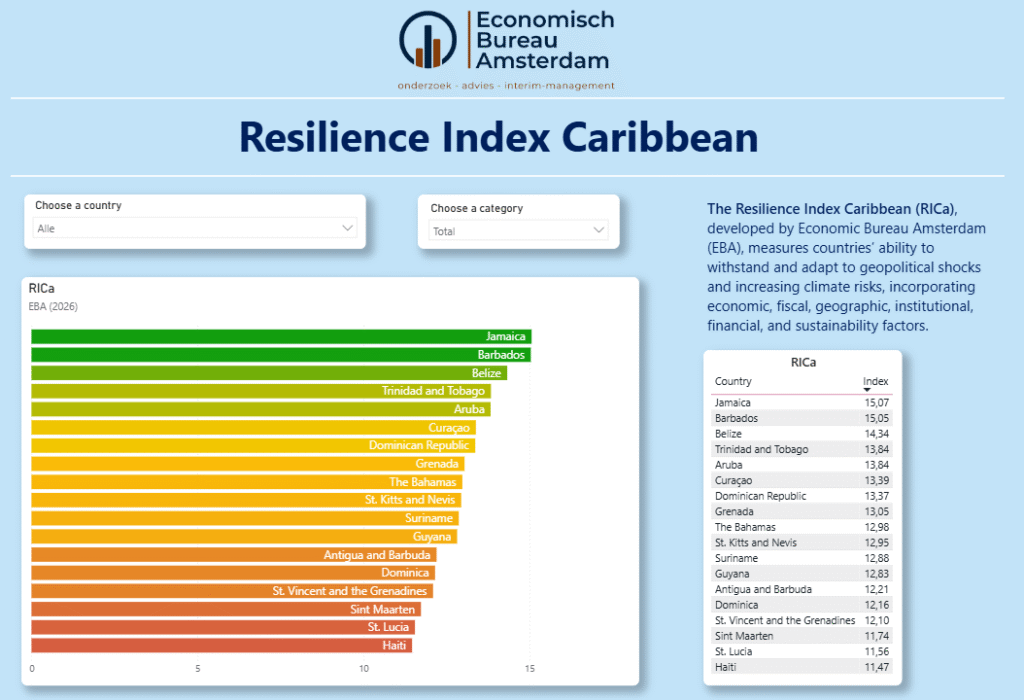
Economic resilience is becoming increasingly important in a world marked by geopolitical uncertainty and climate change. For small and open economies, such as those in the Caribbean, the ability to absorb external shocks and recover from crises is especially relevant. The new Resilience Index Caribbean (RICa), developed by Economic Bureau Amsterdam, provides a tool to measure and compare this multidimensional concept, supporting policymakers in identifying areas to strengthen resilience. The index replaces the Caribbean Investment Climate Index (CICI) which was published by EBA in recent years and consistently ranked Aruba as having the most attractive investment climate.
RICa combines 26 indicators across seven dimensions, including economic structure, fiscal space, financial stability, demographics, institutions, geographic vulnerability and sustainability. It provides both an overall score and insight into the underlying drivers of resilience. The index covers 18 Caribbean countries and is designed as a regional benchmark. By expressing variables relative to country size, the index enables comparison between small and larger economies.
The results show interesting differences across the region. Aruba and Curaçao perform relatively well, supported by strong institutions, favorable public finances and favorable geographic conditions. However, both countries show weaknesses in demographic dynamics and sustainability. Both countries score below average on labor force participation, age dependency and net migration. In addition, both countries have relatively high Co2 emissions per capita. Sint Maarten ranks significantly lower than both Aruba and Curaçao, indicating greater vulnerability to external shocks, among other factors, due to the vulnerability of the labor market, exposure to hurricane risks, and limited sustainability.